From benchmarking to better ideas
Organizational design toolkit: Part 3
Organizations often ask me for benchmarking. How does our structure compare to our peers? Are our teams the right size? Are we spending more or less on administration? These are fair questions, but a number on its own rarely tells you what to do.
What I usually do is closer to a comparative analysis. We look at how similar organizations are set up, and why: what problems they were solving, what they tried and what worked. The goal isn't a score to beat. It's ideas worth considering.
A dozen programs, no perfect match
Some years ago, I worked on a review of a large provincial inspection program. It had hired a large number of new inspectors in a short time, and it was struggling with backlogs, turnover and managers stretched far too thin.
As part of the review, we looked at a dozen other inspection programs across government, from workplace safety to food safety to transportation. One thing became clear almost immediately. None of them was truly comparable. Each had its own mandate, legislation and type of inspection. And yet they faced many of the same challenges (i.e., recruiting and training inspectors, managing workload, keeping inspections consistent and covering a large geography). That's exactly where a comparative analysis earns its keep.
The ideas we found
The programs we spoke with offered a wealth of ideas worth adapting:
- One program trained new inspectors through a kind of apprenticeship, with experienced field staff selected and developed as trainers.
- Another built coaching right into the inspector job description.
- Several used data to track consistency across inspectors and regions.
- Many had worked with their unions on flexible schedules that suited a mobile workforce.
- Most had smaller teams led by front-line supervisors, which I'll come back to in Part 4.
These ideas helped shape recommendations for a central training function, better use of data and more flexible ways of working, all built around the program's own needs.
Every organization needs its own solution
Every organization has its own history, culture, funding and way of working. A structure that works beautifully in one place can fail in another.
The Bridgespan Group, which works with nonprofits, puts it plainly: "Benchmarking is not used to simply copy peers." Its value is in adapting what others have learned to fit your own culture and needs.
Tailored doesn't mean anything goes
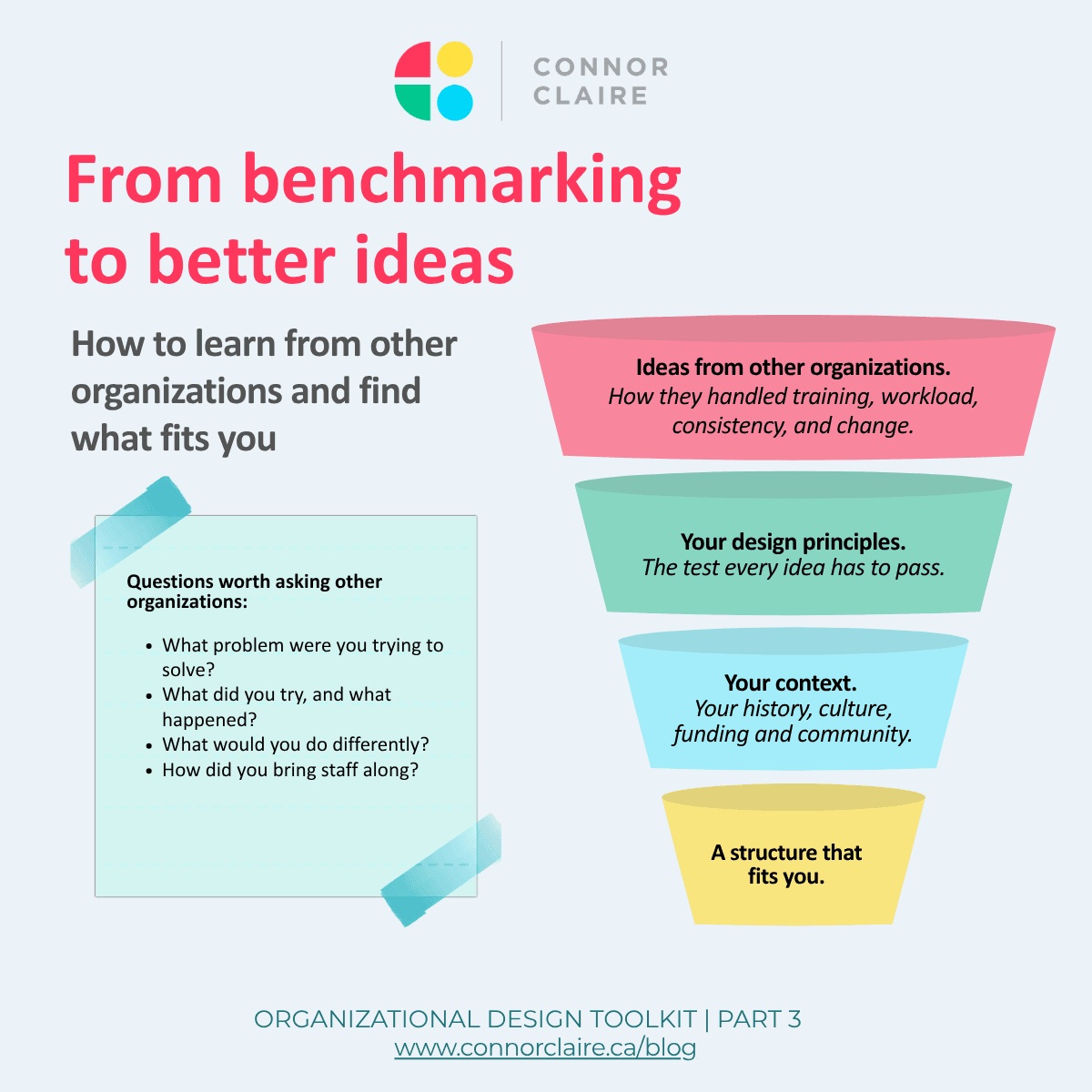
This is why design principles come first, as I described in Part 2. A comparative analysis widens the range of ideas. The principles decide which ones fit. Every idea from another organization has to pass the same test as any other option.
Questions worth asking other organizations
- What problem were you trying to solve?
- What did you try, and what happened?
- What would you do differently?
- How did you bring staff along?
The answers to these questions are where the best ideas usually come from.
Next in this series: span of control, and why there's no magic number.