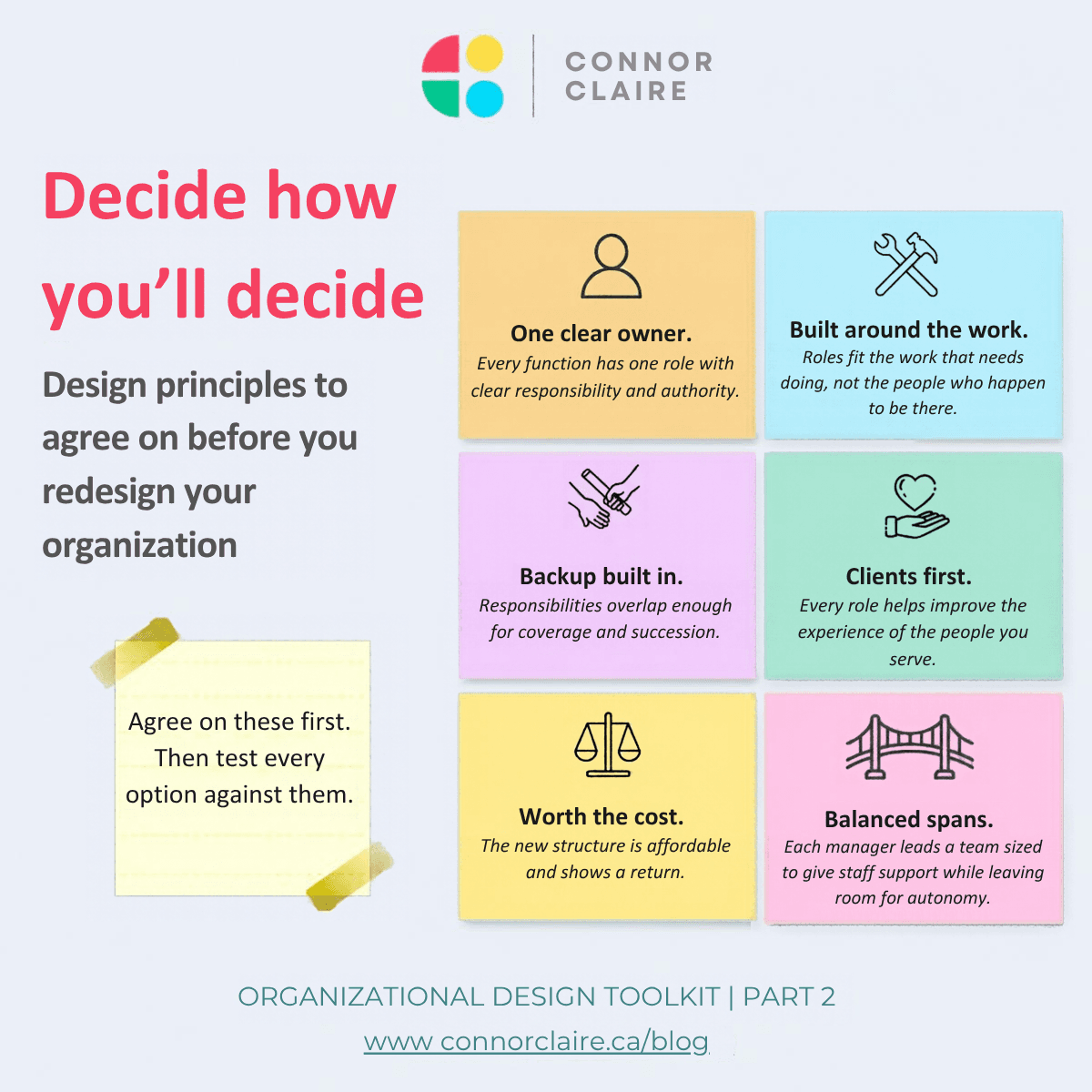
Design Principles: Decide How You'll Decide
Organizational Design Toolkit: Part 2
In Part 1, I described a community agency where skilled, committed staff had become experts at catching each other's falling balls. The organization had drifted out of alignment, and something had to change.
The natural next step would have been to start sketching new org charts. We didn't. Instead, we brought leaders and staff together to agree on something more basic: what any new structure had to do.
The principles came first
Together, the group agreed that in any new design:
- Every key function would have one role with clear responsibility and the authority to match
- Roles would be built around the work, not around the people who happened to be in them
- Responsibilities would overlap enough to provide backup and support succession
- Every role would help improve the experience of clients
- The new structure would have to be worth what it cost
- Spans of control would balance support for staff with room for autonomy
Only then did we start looking at options.
Principles turn opinions into a shared test
Without agreed principles, redesign can easily become a debate about personalities, history or who reports to whom. Principles give everyone the same baseline. Every option is measured against the same test, and the reasons for the final choice are clear to everyone.
They also help people trust the process. In a review of a large provincial program, two of the principles were simple: no reduction in program staff, and no compromise on quality. Stating those commitments up front made it easier for people to engage honestly with the changes that followed.
What happens without them
I've also seen what happens when principles are missing. Many organizations grow organically. A new program arrives, someone capable picks it up, and over time roles take shape around the particular people in them and what they happen to be good at. It works, for a while.
Then someone leaves, or a program changes, and suddenly no one is quite sure who does what. Work falls through the cracks, the people who remain scramble to cover, and the organization realizes its structure was held together by individuals rather than by design.
Principles first, then options
That's why design principles come before any redesign in my work. They keep the process grounded in the organization's own strategy and values. They also become the filter for everything that follows, including what we learn from other organizations.
Next in this series: what you can learn from other organizations.