Is Your Organization Out of Alignment?
Organizational Design Toolkit: Part 1
I once led an organizational review for a community agency facing a major shift in how its services were funded. The staff were skilled, committed and genuinely liked their work. They had also become experts at catching each other's falling balls.
It looked like great teamwork. It was also a sign that the structure no longer matched how the work really got done.
Nothing was broken on its own. The structure, systems and culture had simply drifted out of step with the organization's new reality. When one link breaks, people fill the gap. The people holding it all together were at real risk of burning out.
The real issue is alignment
When an organization is struggling, the organizational chart is often the first thing leaders want to change. Sometimes that's the right call. But more often, the real issue is alignment: whether all the pieces of the organization still fit together.
Hardware and software have to fit together
Ron Carucci and Jarrod Shappell, writing in Harvard Business Review, describe an organization as "a living embodiment of a strategy." They talk about two sides that both have to line up. The hardware is your structure, processes, technology and governance. The software is your values, culture, leadership and the skills of your people. Their research suggests only about 10% of organizations get this alignment right.
For nonprofits, I would add one more piece to the picture: the funding model, mandate and community that shape everything else.
Nonprofits are under real pressure
The Ontario Nonprofit Network's 2025 State of the Sector survey found that 85% of nonprofits saw demand for their services grow last year. Only one in five can fully meet it. Half are struggling to recruit or keep staff, and half of those point to burnout and stress as a reason.
When pressure builds like this, any gap between how an organization is set up and how its work actually gets done becomes much harder to ignore.
Warning signs to watch for
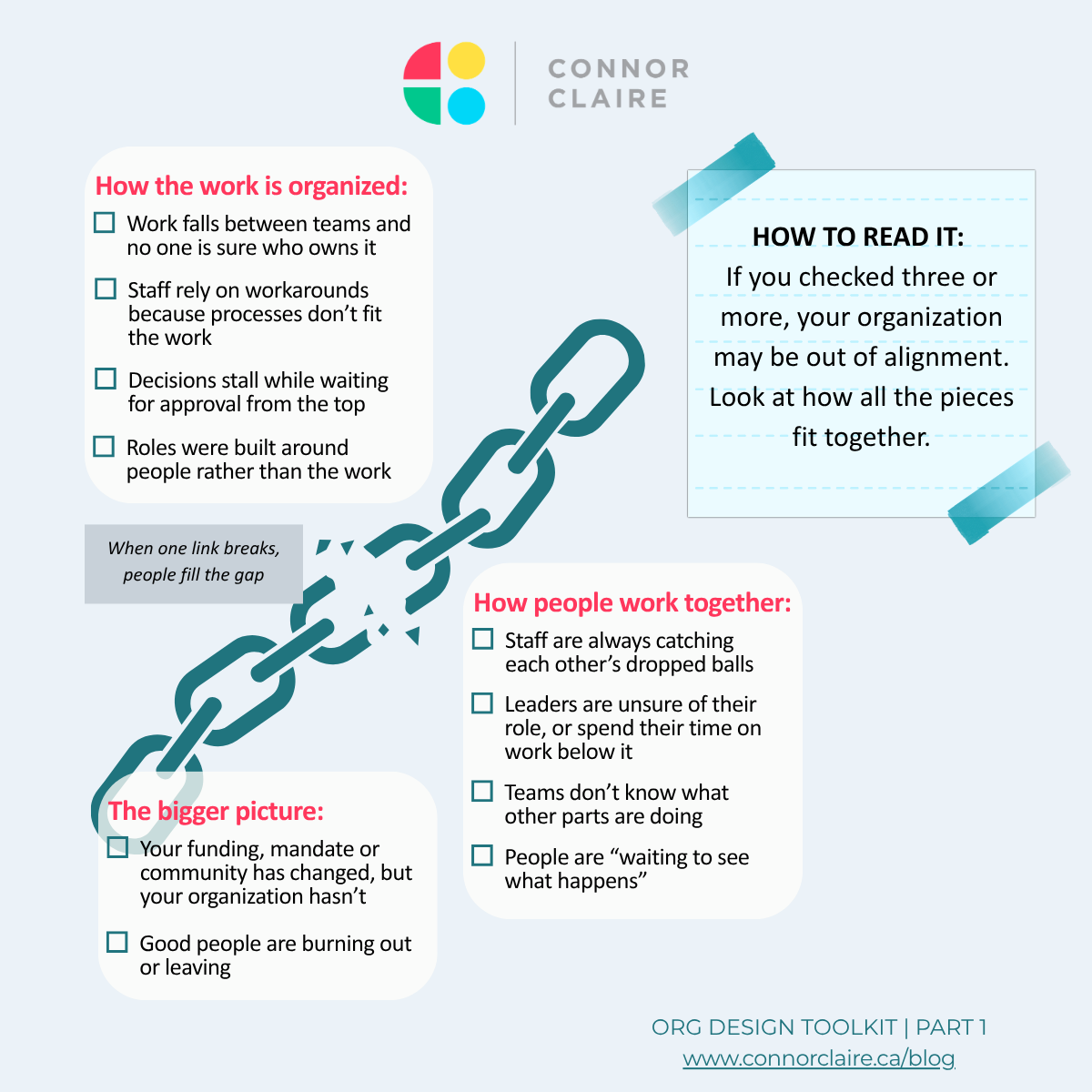
The checklist below pulls together the warning signs I see most often. They fall into three groups: how the work is organized, how people work together, and the bigger picture of funding, mandate and community.
Look at the whole picture first
That's why every organizational review I lead starts with how all the pieces fit together, not with the boxes on the chart. Sometimes the structure does need to change. Sometimes the real fix is in the systems, the roles or the culture around it.
Next in this series: why design principles need to come before anyone draws a new box.